Quality Committee Terms of Reference
Quality Committee
Terms of reference
(Approved by the committee on 10 October 2024
Ratified by the Board of Directors on 28 November 2024)
1. Name of Group / Committee
The name of this committee is the Quality Committee.
2. Composition of the group / committee
The members of the committee and those who are required to attend are shown below together with their role in the operation of the committee.
Members: full rights
| Title | Role in the group / committee |
| Non-executive Director | Chair of the meeting. Non-executive directors provide constructive challenge and strategic guidance, and lead in holding the executive to account. In particular, non-executive directors should scrutinise the performance of the executive management in meeting agreed goals and objectives, receive adequate information and monitor the reporting of performance. They should satisfy themselves as to the integrity of clinical and other information, and make sure that clinical quality controls, and systems of risk management and governance, are robust and implemented
(Code of Governance for NHS Provider Trusts, NHS England 2022) |
| Non-executive Director | Deputy chair of the meeting. Non-executive directors provide constructive challenge and strategic guidance, and lead in holding the executive to account. In particular, non-executive directors should scrutinise the performance of the executive management in meeting agreed goals and objectives, receive adequate information and monitor the reporting of performance. They should satisfy themselves as to the integrity of clinical and other information, and make sure that clinical quality controls, and systems of risk management and governance, are robust and implemented.
(Code of Governance for NHS Provider Trusts, NHS England 2022) |
| Director of Nursing and Professions and Director of Infection Prevention and Control
|
Executive director lead for quality. Chair of the: Patient Experience Group; Trustwide Safeguarding Group; Nursing and Professions Council; and Infection Prevention Control and Medical Devices Group. Assurance and escalation provider to the Quality Committee. |
| Chief Operating Officer | Executive director with responsibility for oversight and delivery and development of Care Services. Assurance and escalation provider to the Quality Committee. |
| Medical Director
|
Joint executive lead for quality. Medical input and Chair of the Trustwide Clinical Governance Group. Assurance and escalation provider to the Quality Committee. |
| Director of People and Organisational Development
|
Staff training and development issues related to quality. Assurance and escalation provider to the Quality Committee. |
| Chief Financial Officer | Executive lead for financial resources including Cost Improvement Programmes. Assurance and escalation provider to the Quality Committee. Attendance at meetings will be dependent on the agenda items being discussed. |
While specified board members will be regular members of the Quality Committee any other board member can attend the meeting on an ad-hoc basis if they wish and will be recognised as a member for that particular meeting and if necessary will count towards the quoracy.
2.1 Attendees
The Quality Committee may also invite other members of Trust staff to attend to provide advice and support for specific items when these are discussed in the committee’s meetings.
These could include, but are not exhaustive to, the following individuals:
- Associate Director for Corporate Governance
- Deputy Director of Nursing
- Clinical Directors
- Head of Nursing and Patient Experience
- Professional and Clinical Leads
2.2 Governor Observers
The role of the governor at Board sub-committee meetings is to observe the work of the committee, rather than to be part of its work as they are not part of the formal membership of the committee. The governor observes Board sub-committee meetings in order to get a better understanding of the work of the Trust and to observe non-executive directors appropriately challenging the executive directors for the operational performance of the Trust.
At the meeting the governor observer will be required to declare any interest they may have in respect of any of the items to be discussed (even-though they are not formally part for the discussion). Governors will receive an information pack prior to the meeting. This will consist of the agenda, the minutes of the previous meeting and summaries of the business to be discussed. Governor observers will be invited to the meeting by the Corporate Governance Team. The chair of the meeting should ensure that there is an opportunity for governor observers to raise any points of clarification at the end of the meeting.
2.3 Associate Non-executive Directors
Associate Non-executive Directors will be invited to attend Board Sub-committee meetings as part of their induction. They will be in attendance at the meeting, in the capacity of observer only, unless invited to contribute by the Chair in circumstances that support the ANEDs development and understanding. This is so the accountability of the substantive members of the committee is maintained.
Associate NEDs will be invited to meetings by the Corporate Governance Team and will be sent copies of the meeting papers.
3. Quoracy
Number: The minimum number of members for a meeting to be quorate is three. This should comprise at least one non-executive director and one executive director. Attendees do not count towards this number. If the chair is unable to attend the meeting, and if otherwise quorate, the meeting will be chaired by the deputy chair.
Non-quorate meeting: Non-quorate meetings may go forward unless the chair decides otherwise. Any decisions made by the non-quorate meeting must be reviewed at the next quorate meeting.
Alternate chair: In the absence of the Chair the alternate chair of the meeting will be another non-executive director.
Deputies: Where appropriate, members may nominate deputies to represent them at a meeting. Deputies do not count towards the calculation of whether the meeting is quorate except if the deputy is representing the member under formal “acting up” arrangements. In this case the deputy will be deemed a full member of the committee. It may also be appropriate for attendees to nominate a deputy to attend in their absence. A schedule of deputies can be found in section 10.
4. Meetings of the committee
Meetings may be held face-to-face or remotely as is considered appropriate. Remote meetings may involve the use of the telephone and / or electronic conference facilities.
Frequency: The Quality Committee will meet monthly to transact its normal business.
Urgent meeting: Any committee member may, through the chair, request an urgent meeting. The chair will normally agree to call an urgent meeting to discuss the specific matter unless the opportunity exists to discuss this in a more expedient manner (for example at a Board meeting).
Administrative support: The Corporate Governance Team will provide secretariat support to the committee.
Minutes: Draft minutes will be sent to the chair for review and approval within seven working days of the meeting.
Papers: Papers for the meeting will be distributed electronically by the Corporate Governance Team five working days prior to the meeting. Papers received after this date will only be included if decided upon by the chair.
5. Authority
Establishment: The Quality Committee is a sub-committee of the Board of Directors and has been formally established by the Board of Directors.
Powers: The Quality Committee is constituted as a standing committee of the Trust Board of Directors. The committee is authorised by the Board to investigate and seek assurance on any activity within its terms of reference.
In consultation with the Board of Directors, the committee is able to access independent professional advice and secure the attendance of persons outside the Trust with relevant experience and expertise if it considers this necessary.
Cessation: The Quality Committee is a standing committee in that its responsibilities and purpose are not time limited. It will continue to meet in accordance with these terms of reference until the Trust Board determines otherwise.
6. Role of the Committee
6.1 Purpose of the committee
The Quality Committee has responsibility for providing assurance to the Board of Directors on the effectiveness of the:
- Trust’s quality, including patient safety, systems and processes
- Quality, including patient safety, of the services provided by the Trust
- control and management of quality, including patient safety, related risks within the Trust.
The quality committee is committed to improving governance on a continuing basis through evaluation and review.
6.2 Guiding principles for members (and attendees) when carrying out the duties of the group / committee
In carrying out their duties members of the committee and any attendees of the committee must ensure that they act in accordance with the values of the Trust, which are:
- we have integrity
- we are caring
- we keep it simple.
6.3 Duties of the group / committee
The Quality Committee is seeking assurance that:
- systems and processes are effective
- quality, including patient safety, of services that the Trust provides is good and continuously improving
- quality of the experience of people using our service is good and continuously improving.
It carries out its duties to provide assurance to the Board of Directors. In addition to this, it is authorised to seek information that will allow it carry out its purpose. It will:
- Seek assurance on systems and processes to ensure monitoring and assessment of the quality, including patient safety, and improvements in services
- Seek assurance on the mechanisms to involve service users, carers, the public and partner organisations in improving services
- Seek assurance on the systems for identifying, reporting, mitigating and managing quality, including patient safety, related risks including the monitoring of incidents, investigations and deaths; and complaints, claims, and compliments
- Review the Board Assurance Framework to seek assurance on behalf of the Board that those strategic risks where it has been listed as an assurance receiver, are being effectively controlled; that the risk score (which has been determined by the executive team) is at the right level; and that any gaps are being addressed appropriately. It may also inform any deep-dive which it may wish to undertake into any area on which is requires further assurance.
- Seek assurance on compliance against the Care Quality Commission’s registration and notification requirements and action plans in response to CQC inspection.
- Monitor, scrutinise and provide assurance to the Board of Directors on the Trust’s compliance with national standards, including the Care Quality Commission’s Fundamental Standards, and the quality elements relating to NHS England’s System Oversight Framework, the quality elements within the NHS Standard contract, NICE guidance and CQUIN schemes.
- Seek assurance on the quality impact assessments for key strategic programs of work
- Receive assurance on the work carried out and reported to the Trustwide Clinical Governance Group, including: Quality Plan; Quality Report; Infection Prevention and Control; Safeguarding; Research and Development; Clinical Audit and NICE; Continuous Improvements; and Measuring outcomes across Trust services
- Receive assurance on activity within operational services that contributes to the understanding and improvement of quality, including patient safety, within the Trust.
- Review the draft Internal Audit Annual work plan so it can be assured on the sufficiency of the work the Auditors will carry out in respect of clinical matters. Assurance on this sufficiency (or comments on any matters that should be included) will be provided to the Audit Committee to allow it to approve the overall plan.
- Have oversight of relevant data and specific initiatives in relation to the Equality and Inclusion Agenda as requested by the Board of Directors, recognising the importance of inclusion and accessibility in delivering quality services.
- Carry out the duties of the Maternity Board Safety Champion, with the chair of the committee being the named champion.
- Carry out the role of Hip Fracture, Falls and Dementia Champion
- Carry out the role of Learning from Deaths Champion
- Carry out the role of Children and Young People Champion
- Carry out the role of Resuscitation Champion
- Carry out the role of Safeguarding Champion
- Carry out the role of Palliative and of Life Care Champion
An assurance and escalation report will be made to the Board of Directors by the Chair of the committee
7. Relationship with other groups and committees
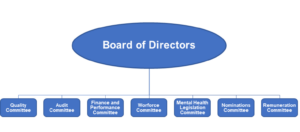
The Quality Committee does not have any sub-committees. It is linked to the Trustwide Clinical Governance Group as an assurance receiver. The Quality Committee provides a route of escalation for this group to the Board of Directors. Although this does not preclude any other group being asked to provide assurance. The committee has a duty to work with other Board sub-committees to ensure matters are not duplicated.
8. Duties of the chairperson
The Chair of the committee shall be responsible for:
- agreeing the agenda with the Director of Nursing, Quality and Professions and the Medical Director
- directing the conduct of the meeting ensuring it operates in accordance with the Trust’s values
- giving direction to the Committee Secretariat
- ensuring all members have an opportunity to contribute to the discussion
- ensuring the agenda is balanced and discussions are productive, and when they are not productive they are efficiently brought to a conclusion
- deciding when a matter requires escalation to the Board of Directors
- checking the minutes
- ensuring key information is presented to the Board of Directors in respect of the work of the committee
- ensuring that governor observers are offered an opportunity at the end of the meeting to raise any points of
In the event of there being a dispute between any ‘groups’ in the hierarchy (in the case of this Board sub-committee, this would be between the Board and the Quality Committee and, in recognition of the nature of matrix working between the work of all Board sub-committees, the Quality Committee and any other Board sub-committee) it will be for the chairs of those groups to ensure there is an agreed process for resolution; that the dispute is reported back to the ‘groups’ concerned; and that when a resolution is proposed regarding the outcome this is also reported back to the ‘groups’ concerned for agreement.
The chair of the Quality Committee will also be the named Maternity Board Safety Champion, with the requirements of the role to be discharged through the committee.
9. Review of the terms of reference and effectiveness
The terms of reference shall be reviewed by the committee at least annually, and then presented to the Board of Directors for ratification. This will also occur throughout the year if a change has been made to them.
In addition to this the chair must ensure the committee carries out an annual assessment of how effectively it is carrying out its duties and make a report to the Board of Directors including any recommendations for improvement.
Appendix 1a – Schedule of deputies
| Full member (by job title) | Deputy (by job title) |
| NED Chair | Second NED |
| NED member | None |
| Director of Nursing and Professions / Director of Infection Prevention and Control | Deputy Director of Nursing |
| Chief Operating Officer | Deputy Director of Operations |
| Director of People and Organisational Development | Associate Director |
| Medical Director | Clinical Director |