Finance and Performance Committee Terms of Reference
Finance and Performance Committee
Terms of reference
(Ratified by the Board of Directors on 28 November 2024)
1. Name of committee
The name of this committee is the Finance and Performance Committee.
2. Composition of the committee
The members of the Committee and those who are required to attend are shown below together with their role in the operation of the Committee.
Members: full rights
| Title | Role in the Committee |
| Non-executive Director
(Committee Chair) |
Non-executive directors provide constructive challenge and strategic guidance, and lead in holding the executive to account. In particular, non-executive directors should scrutinise the performance of the executive management in meeting agreed goals and objectives, receive adequate information and monitor the reporting of performance. They should satisfy themselves as to the integrity of clinical and other information, and make sure that clinical quality controls, and systems of risk management and governance, are robust and implemented.
(Code of Governance for NHS Provider Trusts, NHS England 2022) |
| Non-executive Director
(Additional non-executive member (see section 3) – Chair of the Audit Committee) |
Non-executive directors provide constructive challenge and strategic guidance, and lead in holding the executive to account. In particular, non-executive directors should scrutinise the performance of the executive management in meeting agreed goals and objectives, receive adequate information and monitor the reporting of performance. They should satisfy themselves as to the integrity of clinical and other information, and make sure that clinical quality controls, and systems of risk management and governance, are robust and implemented.
(Code of Governance for NHS Provider Trusts, NHS England 2022) |
| Non-executive Director
(Additional non-executive member (see section 3) – Deputy Chair of the Committee, they must not also be the Chair of the Audit Committee) |
Non-executive directors provide constructive challenge and strategic guidance, and lead in holding the executive to account. In particular, non-executive directors should scrutinise the performance of the executive management in meeting agreed goals and objectives, receive adequate information and monitor the reporting of performance. They should satisfy themselves as to the integrity of clinical and other information, and make sure that clinical quality controls, and systems of risk management and governance, are robust and implemented.
(Code of Governance for NHS Provider Trusts, NHS England 2022) |
| Chief Financial Officer | Executive lead for financial resources within the Trust. Assurance and escalation provider to the Finance and Performance Committee. |
| Chief Operating Officer | Executive Director with responsibility for the oversight and delivery and development of Care Services. Assurance and escalation provider to the Finance and Performance Committee. |
| Director of People and Organisational Development | Executive lead for workforce development. Assurance and escalation provider to the Finance and Performance Committee. |
| Director of Nursing and Professions / Director of Infection Prevention and Control | Executive lead for quality. Assurance and escalation provider to the Finance and Performance Committee. |
While specified Board members will be regular members of the Finance and Performance Committee any other Board member can attend the meeting on an ad-hoc basis if they wish and will be recognised as a member for that particular meeting and if necessary, will count towards the quoracy.
In attendance: in an advisory capacity
The Committee may also invite other members of Trust staff and partners to attend to provide advice and support for specific items from its work plan when these are discussed at the Committee’s meetings.
These could include, but are not exhaustive to, the following individuals:
- Assistant Director of Finance
- Associate Director for Corporate Governance
- Associate Director of Estates and Facilities
- Chief Digital Information Officer
- Deputy Director of Finance
- Head of Procurement
- Managing Director of North of England Commercial Procurement Collaborative
- Managing Director of Thrive by Design (previously mHabitat).
Non-executive directors are also welcome to observe Board sub-committee meetings that they are not a member of as part of their development.
In addition to anyone listed above as a member, at the discretion of the Chair of the Committee the Finance and Performance Committee may also request individuals to attend on an ad-hoc basis to provide advice and support for specific items from its work plan when these are discussed in the meetings.
2.1 Governor Observers
The role of a governor at Board sub-committee meetings is to observe the work of the Committee, rather than to be part of its work as they are not part of the formal membership of the Committee. The governor observes Board sub-committee meetings in order to get a better understanding of the work of the Trust and to observe non-executive directors appropriately challenging the executive directors for the operational performance of the Trust.
At the meeting the governor observer will be required to declare any interest they may have in respect of any of the items to be discussed (even though they are not formally part of the discussion). Governors will receive an information pack prior to the meeting. This will consist of the agenda, the minutes of the previous meeting and summaries of the business to be discussed. Governor observers will be invited to the meeting by the Corporate Governance Team. The chair of the meeting should ensure that there is an opportunity for governor observers to raise any points of clarification at the end of the meeting.
2.2 Associate Non-executive Directors
Associate Non-executive Directors will be invited to attend Board sub-committee meetings as part of their induction. They will be in attendance at the meeting, in the capacity of observer only, unless invited to contribute by the Chair in circumstances that support the Associate NEDs’ development and understanding. This is so the accountability of the substantive members of the Committee is maintained.
Associate NEDs will be invited to meetings by the Corporate Governance Team and will be sent copies of the meeting papers.
3. Quoracy
Number: The minimum number of members for a meeting to be quorate is three. This should comprise at least one non-executive director and one executive director. Attendees do not count towards quoracy. If the Chair is unable to attend the meeting, and if otherwise quorate, the meeting will be chaired by the Deputy Chair of the Committee.
Deputies: Where appropriate members may nominate deputies to represent them at a meeting. Deputies do not count towards the calculation of whether the meeting is quorate except if the deputy is representing the member under formal “acting up” arrangements. In this case the deputy will be deemed a full member of the Committee.
It may also be appropriate for attendees to nominate a deputy to attend in their absence.
A schedule of deputies, attached at appendix 1a, should be reviewed at least annually to ensure adequate cover exists.
Non-quorate meeting: Non-quorate meetings may go ahead unless the Chair decides not to proceed. Any decisions made by the non-quorate meeting must be reviewed at the next quorate meeting.
Alternate chair: The unique character of Board sub-committees is that they are chaired by a non-executive director. If the Chair cannot attend this meeting another non-executive director would chair this Committee. However, if one of the other non-executive directors that is a member of this Committee is also the Chair of the Trust’s Audit Committee then they are not eligible to chair this Committee. This is in keeping with best practice to ensure that the Chair of the Audit Committee is seen to be suitably independent. In this circumstance the other non-executive director who is a member of this meeting would be the Deputy Chair for this Committee. In exceptional cases such as a non-executive director vacancy on the Committee, the Chair of the Audit Committee would be asked to chair the meeting if the assigned Chair is unable to attend the meeting.
4. Meetings of the committee
Meetings may be held face-to-face or remotely as is considered appropriate. Remote meetings may involve the use of the telephone and / or electronic conference facilities.
Frequency: The Finance and Performance Committee will meet up to eight times a year or as agreed by the Committee. The Committee will meet following the NHS England quarter close downs and there will be up to another four meetings scheduled each financial year.
Urgent meeting: Any member of the Committee may request an urgent meeting. The Chair will normally agree to call an urgent meeting to discuss the specific matter unless the opportunity exists to discuss the matter in a more expedient manner.
Administrative support: The Corporate Governance Team will provide secretariat support to the Committee.
Minutes: Draft minutes will be sent to the Chair for review and approval within seven working days of the meeting.
Papers: Papers for the meeting will be distributed electronically by the Corporate Governance Team a minimum of three working days prior to the meeting. This is so the circulation of papers is aligned to that of the Board of Directors. Papers received after this date will only be included if decided upon by the Chair.
5. Authority
Establishment: The Finance and Performance Committee is a sub-committee of the Board of Directors and has been formally established by the Board of Directors.
Powers: Its powers, in addition to the powers vested in the executive members in their own right, are detailed in the Trust’s Scheme of Delegation.
In consultation with the Board of Directors, the Committee is able to access independent professional advice and secure the attendance of persons outside the Trust with relevant experience and expertise if it considers this necessary.
Cessation: The Finance and Performance Committee is a standing committee in that its responsibilities and purpose are not time limited. However, the Committee has a responsibility to review its effectiveness annually and on the basis of this review and if agreed by a majority of members the Chair may seek Board authority to end the Finance and Performance Committee’s operation.
In addition, the Trust should periodically review its governance structure for continuing effectiveness and as a result of such a review the Board may seek the winding up of the Finance and Performance Committee.
6. Role of the committee
6.1 Purpose of the committee
The principal purpose of the Finance and Performance Committee is to provide the Board with assurance on financial governance and performance; strategic matters in relation to procurement, estates, information technology and information management; clinical activity and key performance indicators.
6.2 Guiding principles for members (and attendees) when carrying out the duties of the committee
In carrying out their duties members of the Committee and any attendees of the Committee must ensure that they act in accordance with the values of the Trust, which are:
- we have integrity
- we are caring
- we keep it simple.
6.3 Duties of the committee
The Finance and Performance Committee has the following duties.
General governance duties
- ratify plans, policies and procedures relevant to the remit of the Committee, this includes approval of the Trust’s Financial Procedure and the Standing Financial Instructions prior to the Board of Directors ratifying them
- develop a forward plan for the work of the Committee that ensures proper oversight and consideration of all mandatory and statutory declarations is scheduled into the business of the Committee
- to review the Board Assurance Framework to ensure that the Board of Directors receives assurances that effective controls are in place to manage strategic risks related to any area of the Finance and Performance Committee’s responsibilities.
Financial governance
Receiving assurance that:
- the Trust has high standards of financial management and that financial systems and procedures promote the efficient and economical conduct of business and safeguard financial propriety and regularity throughout
- financial considerations are fully taken into account in decisions within the Trust and that there is effective management of financial and operational business risks in the organisation
- the Trust is reviewing the impact of any issues that may affect mandatory and regulatory financial duties operationally
- the Trust is complying with the Licence holder’s duty to operate efficiently, economically and effectively and has effective financial decision-making, management and control in place
Procurement
Receiving assurance that:
- the Trust’s Procurement Plan is driving reductions in all non-pay expenditure and progressing as originally intended
- operational reports are reviewed regarding compliance with effective procurement procedures with lessons learnt being implemented
- the Trust has a system to minimise the risk of Standing Financial Instruction and EU Procurement Law breaches for all Trust non-pay expenditure.
Financial strategy
- review the detailed medium term financial plans as part of the annual Strategic Plan, prior to ratification by the Board of Directors and onward submission to NHS England
- scrutinise the quarterly financial reports to NHS England and provide assurance to the Board of Directors on the continuity of services rating, to ensure compliance with the Risk Assessment Framework
- review and monitor the financial impact and achievement of cost improvement plans.
Receiving assurance:
- regarding the Trust’s contracting performance and the robustness of information provided to document activity
- on the on-going development of payment mechanisms and tariff system within the Trust to ensure that these are effective and will be deployed meeting national targets and mandatory guidance.
IT and information governance
Receiving assurance:
- approve the Trust’s Health Informatics Plan and receive assurance that it is progressing as originally intended
- Chair’s reports from the Information Governance Group.
Capital and estates
Receiving assurance that:
- the Trust’s Strategic Estates Plan is progressing as originally intended
- actions related to the Trust’s capital programme are being taken forward operationally and advising the Board of Directors of issues that needed to be escalated
- action is being taken operationally relating to the Trust’s estate from regulatory and statutory bodies and in respect to sustainability.
Performance
Receiving assurance on the Trust’s performance against:
- annual budgets, capital plans, and the Cost Improvement Programme
- quality, innovation, productivity, and prevention plans
- clinical activity and key performance indicators.
Internal Audit
- The Committee will also review the draft Internal Audit Annual work plan so it can be assured on the sufficiency of the work the Auditors will carry out in respect of matters pertaining to the duties of the Committee. Assurance on the plan’s sufficiency (or comments on any matters that should be included) will be provided to the Audit Committee to allow it to approve the overall plan.
7. Relationship with other groups and committees
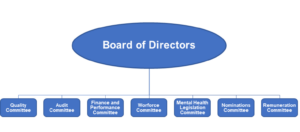
The Finance and Performance Committee does not have any sub-committees. It is linked to the Information Governance Group as an assurance receiver. The Finance and Performance Committee provides a route of escalation for this group to the Board of Directors. Although this does not preclude any other group being asked to provide assurance. The Committee has a duty to work with other Board sub-committees to ensure matters are not duplicated.
Reporting
The Finance and Performance Committee will receive an assurance report from the Information Governance Group. An assurance and escalation report will be made to the Board of Directors by the Chair of the Committee.
Links with operational processes
The Finance and Performance Committee will receive high level reports from operational functions such as estates, informatics, and the North of England NHS Commercial Procurement Collaborative.
In addition to this, operational groups within the Chief Financial Officer’s portfolio will report any significant governance implications by way of highlight reports into the Finance and Performance Committee. Groups dealing with the following areas have thus far been identified:
- Estates Steering Group
- Financial Planning Group
- Digital Steering Group
- Procurement Steering Group
- Emergency Preparedness Resilience and Response Group (this group sits within the Chief Operating Officer’s portfolio).
8. Duties of the chairperson
The Chair of the Committee shall be responsible for:
- agreeing the agenda with the Chief Financial Officer and Chief Operating Officer
- directing the meeting ensuring it operates in accordance with the Trust’s values whilst ensuring everyone at the meeting has a reasonable chance to contribute to the discussion
- giving direction to the minute taker and checking the minutes
- ensuring the agenda is balanced
- ensuring discussions are productive, and when they are not productive, they are efficiently brought to a conclusion
- deciding when it is beneficial to vote on a motion or decision
- ensuring sufficient information is presented to the Board of Directors in respect of the work of the Committee
- ensuring the Chair’s report is submitted to the ‘parent’ committee as soon as possible
- ensuring that governor observers are offered an opportunity at the end of the meeting to raise any points of
It will be the responsibility of the Chair of the Finance and Performance Committee to ensure that it (or any group / committee that reports to it) carries out an assessment of effectiveness annually, and ensure the outcome is reported to the Board of Directors along with any remedial action to address weaknesses. The Chair will also be responsible for ensuring that the actions to address any areas of weakness are completed.
In the event of there being a dispute between any ‘groups’ in the hierarchy (in the case of this Board sub-committee, this would be between the Board and the Finance and Performance Committee and, in recognition of the nature of matrix working between the work of all Board sub-committees, the Finance and Performance Committee and any other Board sub-committee) it will be for the chairs of those ‘groups’ to ensure there is an agreed process for resolution; that the dispute is reported back to the ‘groups’ concerned; and that when a resolution is proposed regarding the outcome this is also reported back to the ‘groups’ concerned for agreement.
9. Review of the terms of reference and effectiveness
The terms of reference shall be reviewed by the Committee at least annually in September and be presented to the Board of Directors for ratification, where there has been a change.
In addition to this the Chair must ensure the Committee carries out an annual assessment in July of how effectively it is carrying out its duties and make a report to the Board of Directors including any recommendations for improvement.
Appendix 1a – Schedule of deputies
It may not be necessary or appropriate for all members (or attendees) to have a deputy attend in their absence. If this is the case, please state below “no deputy required”.
| Committee Member | Deputy |
| NED Chair | Deputy Chair of the Committee |
| NED member | Another NED |
| NED member | Another NED |
| Chief Financial Officer | Deputy Director of Finance |
| Chief Operating Officer | Deputy Director of Operations |
| Director of People and Organisational Development | Associate Director of Employment / Associate Director for People Resourcing and Organisational Development |
| Director of Nursing and Professions | Deputy Director of Nursing |