Nominations Committee Terms of Reference
Nominations Committee
Terms of reference
(Approved by the committee on 31 March 2022
Ratified by the Board of Directors on 19 May 2022)
1. Name of group / committee
The name of this committee is the Nominations Committee
2. Composition of the Committee
The members of the committee and those who are required to attend are shown below together with their role in the operation of the committee.
Members
| Title | Role in the committee |
| Chair of the Trust | Committee chair and responsible for evaluating the assurance given and identifying if further consideration action is needed. |
| Two non-executive directors | Responsible for evaluating the assurance given and identifying if further consideration / action is needed.
The Deputy Chair would normally chair the committee in the absence of the Chair of the Trust or another non-executive member may chair if the Deputy Chair is absent. |
| The Chief Executive | Responsible for evaluating the assurance given and identifying if further consideration / action is needed and providing further specific information and input in respect of executive director appointments |
| Director of People and Organisational Development | Responsible for evaluating the assurance given and identifying if further consideration / action is needed and providing further specific information and input in respect of employment law and practice. |
Only members of the committee have the right to attend committee meetings. However, other individuals, including external advisors, may be invited to attend the meeting, at the discretion of the chair of the meeting.
In attendance
| Title | Role in the committee | Attendance guide |
| Associate Director of Corporate Governance (acting as Trust Board Secretary) | Committee support and advice and Board of Directors’ governance | Every meeting |
A schedule of deputies for those in attendance is set out at appendix 1.
2.1 Associate Non-executive Directors
Associate Non-executive Directors will be invited to attend Board Sub-committee meetings as part of their induction. They will be in attendance at the meeting, in the capacity of observer only, unless invited to contribute (in exceptional circumstances) by the Chair. This is so the accountability of the substantive members of the committee is maintained.
Associate NEDs will be invited to meetings by the Corporate Governance Team and will be sent copies of the meeting papers.
3. Quoracy
Number: The minimum number of members for a meeting to be quorate shall be three members. Attendees do not count towards this number. If the Chair of the Trust is unable to attend the meeting, and if otherwise quorate, the meeting will be chaired by another non-executive member.
Deputies: Attendees may nominate a deputy to attend in their absence. A schedule of deputies is attached at appendix 1.
Non-quorate meeting: Non-quorate meetings may go forward unless the chair decides otherwise. Any decisions made by the non-quorate meeting must be reviewed at the next quorate meeting.
4. Meetings of the Committee
Meetings may be held face-to-face or remotely as is considered appropriate. Remote meetings may involve the use of the telephone and / or electronic conference facilities.
Frequency: The Nominations Committee will meet as required.
Urgent meeting: Any committee member may, through the chair, request an urgent meeting. The chair will normally agree to call an urgent meeting to discuss the specific matter unless the opportunity exists to discuss this in a more expedient manner (for example at a Board meeting).
Minutes: The Associate Director of Corporate Governance will take minutes of the meeting.
Draft minutes will be circulated to the chair of the committee no later than two weeks after the meeting. Actions from the meeting will be circulated to relevant members within 10 working days from the day of the meeting taking place.
5. Authority
Establishment: In accordance with The Code of Governance for NHS Foundation Trusts and the Trust’s Constitution.
Powers: The Nominations Committee is constituted as a standing committee of the Board and has no executive powers, other than those specifically delegated in these terms of reference. Its constitution and terms of reference are set out below and can only be amended with the approval of the Trust Board.
The committee is authorised by the Board to investigate and carry out any activity within its terms of reference. It is authorised to seek any information it requires from any employee of the Trust and all employees are directed to cooperate with any request made by the committee.
The committee is authorised by the Board to obtain outside legal or other independent professional advice and to secure the attendance of individuals and authorities from outside the Trust with relevant experience and expertise if it considers this necessary for, or expedient to the exercise of its functions.
Cessation: The Nominations Committee is a standing committee in that its responsibilities and purpose are not time limited. While the functions of a Nominations Committee are required by NHS Improvement the exact format may be changed with the approval of the Board of Directors, but this will always include the core role as set out in the Code of Governance.
6. Role of the Committee
6.1 Purpose of the Committee
The purpose of the Nominations Committee is to regularly review the structure, size and composition of the board of directors and make recommendations for changes where appropriate. In particular, the committee should evaluate the balance of skills, knowledge and experience on the board of directors. It shall also have a role in ensuring appropriate succession plans are in place for members of the executive team. In relation to the appointment of executive and non-executive directors the committee shall prepare a description of the role and capabilities required for appointment of both executive and non-executive directors, including the Chair of the Trust.
With regard to Health and Social Care Act 20018 (Regulated Activities) Regulations 2014 Regulation: 5 Fit and Proper Persons Test: Directors the Nominations Committee shall be responsible for receiving and considering any information in relation to any current executive director who is reportedly not a ‘fit and proper person’ and decide on any action to be taken.
The committee shall execute its role by adding to the assurance around the Trust’s goals:
- People achieve their agreed goals for improving health and improving lives
- People experience safe care
- People have a positive experience of their care and support.
The remit of the Nominations Committee enables it to seek assurance in the areas of the following strategic objectives:
| Objective | Committee roles |
| Quality and outcomes | The Nominations Committee has a key role regarding the recruitment of appropriately qualified, experienced and ‘fit and proper’ members of the Board of Directors by looking at the balance of skills and knowledge required on the Board when a vacancy arises. |
| Governance and compliance | The Nominations Committee has a core responsibility to ensure compliance with all legal obligations, regulations, codes and recommendations of the Department of Health and NHS in terms of the appointment of directors and the balance of the Board. |
6.2 Guiding principles for members (and attendees) when carrying out the duties of the Nominations Committee
In carrying out their duties members of the group and any attendees of the committee must ensure that they act in accordance with the values of the Trust, which are:
- We have integrity
- We are caring
- We keep it simple.
6.3 Duties of the Nominations Committee
The following shall be those items which will form the duties of the committee:
Structure, size and composition of the Board of Directors
- Regularly review the structure, size and composition (including the skills knowledge, experience and diversity) of the Board, making use of the output of the Board evaluation process as appropriate and keep the leadership needs of the Trust under review to ensure continued ability of the Trust to operate in the health economy
- Prepare a description of the role and competencies (by way of a person specification) required for any vacancy that arises on the Board of Directors (executive or non-executive director)
- Review information received about any current ED who is reportedly not a ‘fit and proper person’, consider the matter, instigate any investigation (as necessary), review the outcome of the investigation and agree what course of action to take.
Non-executive director appointments
- Where the appointment is of a non-executive director prepare / approve a role description and a person specification setting out the competencies required and advise the Appointments and Remuneration Committee of the specific and generic skills etc to be appointed to (it shall be for that committee to oversee the process of appointment for non-executive director vacancies)
- For the appointment of a chair, the nominations committee should not only define the role and capabilities required but should also include an assessment of the time commitment expected, recognising the need for availability in the event of emergencies.
Executive director appointments
- Where the appointment is that of an executive director prepare / approve a job description for use in the recruitment and appointment process
- Approve the procedure and documentation for the appointment of any executive director or Chief Executive (the appointment process will be carried out by a panel as described in Schedule 7 paragraph 17(4) of the NHS Act 2006 as a minimum composition)
- Make a recommendation to the Council of Governors on the appointment of the Chief Executive (it shall be for the Council to approve the appointment of any new Chief Executive as per Schedule 7 paragraph 17(5) of the NHS Act 2006)
Succession planning
- Give full consideration to and make plans for succession planning for the Chief Executive and other executive directors taking into account the challenges and opportunities facing the Trust and the skills and expertise needed on the Board in the future
Other
- To undertake any other duties as may be directed by the Board from time-to-time.
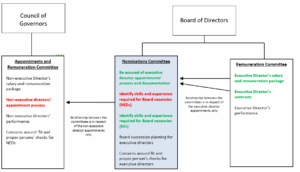
7. Relationship with other Groups and Committees
The Nominations Committee shall have a direct relationship with other committees as shown below:
8. Duties of the Chair
The chair of the group shall be responsible for:
- Agreeing the agenda with the Head of Corporate Governance
- Directing the conduct of the meeting ensuring it operates in accordance with the Trust’s values
- Giving direction to the minute taker
- Ensuring all attendees have an opportunity to contribute to the discussion
- Ensuring the agenda is balanced and discussions are productive, and when they are not productive they are efficiently brought to a conclusion
- Deciding when information or matters presented to the Nominations Committee need escalation to the Board of Directors
- Checking the minutes
- Ensuring sufficient information is presented to the Board of Directors in respect of the work of the committee.
It will be the responsibility of the chair of the Nominations Committee to ensure that the committee carries out an assessment of the committee’s effectiveness annually, and ensure the outcome is reported to the Board of Directors along with any remedial action to address weaknesses. The chair will also be responsible for ensuring that the actions to address any areas of weakness are completed.
In the event of there being a dispute between any ‘groups’ in the hierarchy (in the case of this Board sub-committee, this would be between the Board and the sub-committee committee and, in recognition of the nature of matrix working between the work this Board sub-committee and any other Board sub-committee) it will be for the chairs of those ‘groups’ to ensure there is an agreed process for resolution; that the dispute is reported back to the ‘groups’ concerned; and that when a resolution is proposed the outcome this is also reported back to the ‘groups’ concerned for agreement.
9. Review of the Terms of Reference and Effectiveness
The terms of reference shall be reviewed by the committee at least annually, and then presented to the Board of Directors for ratification, where there has been a change.
In addition to this the chair must ensure the committee carries out an annual assessment of how effectively it is carrying out its duties and make a report to the Board of Directors including any recommendations for improvement
Appendix 1 – Schedule of Deputies
| Attendee (by job title) | Deputy (by job title) |
| Chief Executive | Deputy Chief Executive |
| Director of People and Organisational Development | No deputy identified |
| Associate Director for Corporate Governance | Head of Corporate Governance |