Football fan visits Yorkshire and Humber Mother and Baby Unit to raise awareness of postpartum psychosis
A football fan on a mission to raise awareness of postpartum psychosis has visited the Yorkshire and Humber Mother and Baby Unit at The Mount in Leeds, ahead of attending Leeds United’s match against Newcastle United.
Chris Wasley, a dad and peer supporter with national charity Action on Postpartum Psychosis (APP), is visiting Mother and Baby Units across the country alongside football grounds, using the clubs and their large audiences to help more people understand postpartum psychosis and the specialist support available to families.
The Yorkshire and Humber Mother and Baby Unit provides specialist inpatient care for women experiencing significant mental health difficulties during pregnancy or after childbirth. It allows mothers to receive treatment while continuing to care for their babies, supporting both their recovery and their relationship with their baby.
Chris was given a tour of the unit by Clinical Team Manager Shannon Goode and Dr Gopi Narayan, Consultant Perinatal Psychiatrist, and spoke to staff about the care provided to mothers, babies and their families.
Thrown in at the deep end
His interest in raising awareness comes from his own experience. Following the birth of his son, Chris’s wife experienced postpartum psychosis and was admitted to a Mother and Baby Unit in Bournemouth.
For Chris, one of the biggest lessons from the experience was how little he knew about the illness before it happened and how important support is for dads.
“I think just knowing this existed would have been a massive help,” he said.
Chris says knowing more about postpartum psychosis and the warning signs could have helped him recognise what was happening sooner. He says postpartum psychosis wasn’t something that had been discussed with the midwives involved in his family’s care.
As a first-time dad, he initially assumed the changes he was seeing in his wife were hormones or the “baby blues”. But postpartum psychosis is different. It is a rare but serious mental illness that can develop rapidly after childbirth, with symptoms including hallucinations, delusions, confusion and extreme changes in mood or behaviour.
He quickly found himself having to take a leading role in caring for his wife and their new baby while trying to understand what was happening.
“I suddenly found myself in a situation I never expected to be in, with so much happening at once. I had to upskill really quickly while also adapting to everything else that was going on,” he said. “I was thrown in the deep end.”
His family went on to experience several relapses. Chris says that having access to specialist support made a significant difference, while later experiences outside the Mother and Baby Unit showed him how difficult it could be when professionals did not have the same understanding of postpartum psychosis.
Chris says he would have returned to an MBU “in a heartbeat” if that had been possible.
“When you got there, people understood,” he said. “I knew the Mother and Baby Unit was the best place to be.”
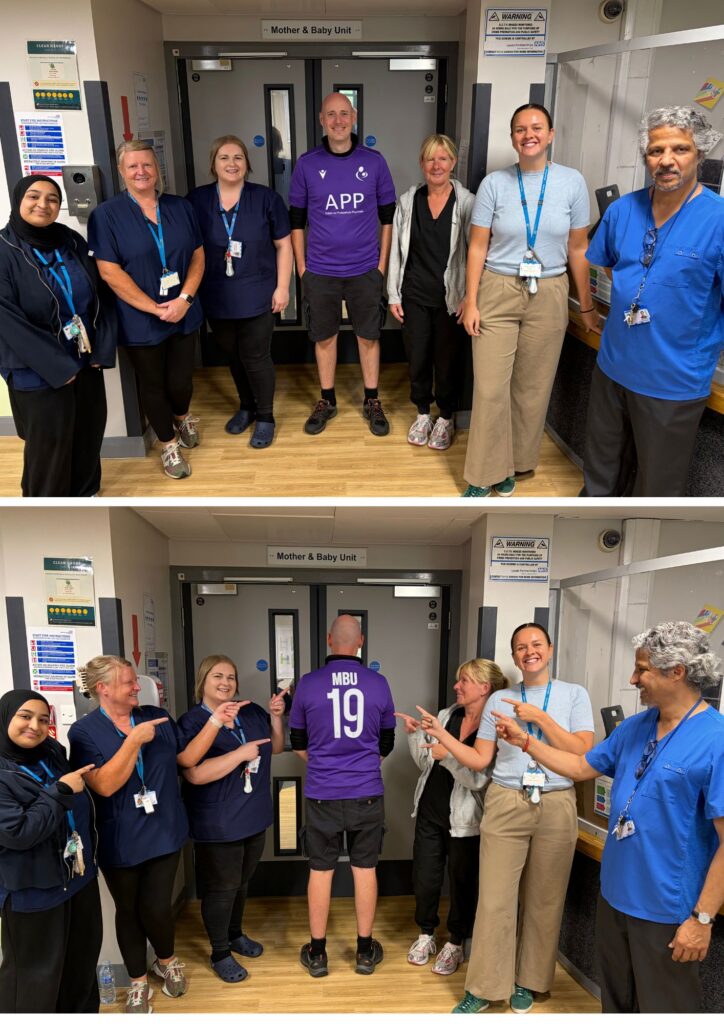
Chris had a football shirt specially made for his 19 MBU visits.
Finding support for dads
Today, Chris is a regional representative and peer supporter for APP, using his own experience to support other families and raise awareness of the illness.
During his visit to The Mount, Chris also spoke with Carrie Waddingham, a peer support worker at the unit who has her own experience of perinatal mental health.
Carrie highlighted the importance of supporting partners and dads as well as mums. The Yorkshire and Humber Mother and Baby Unit now provides partners with an assessment and a link with the service, giving them dedicated time away from the ward to focus on their own wellbeing. This is something Chris says was not available in the same way when his family went through their experience.
The unit is also developing its support for dads and partners, including a new six-session course, Understanding Your Baby, which covers psychoeducation, baby care, mental health care and signposting to organisations including APP and PANDAS.
For Chris, that sense of shared experience can make a huge difference.
“Unfortunately, illnesses like Postpartum Psychosis do happen, often out of the blue,” he said. “It is so reassuring to know that you’re not on your own. Having an understanding without needing to explain everything can mean so much.”
Taking the message to football fans
Leeds was his 16th football match as part of the challenge. He contacts clubs in advance to explain what he is doing and, where possible, works with them to get the message in front of fans. His purple APP football shirt has become a familiar sight, and he has appeared in matchday programmes, on stadium scoreboards and on the pitch before matches. Football gives him a way to reach people he might not otherwise encounter.
Chris joked that he doesn’t usually bring much luck to the home side. This time, however, Leeds United came away with a 4-1 win over Newcastle United.
“I’ve always loved football,” he said. “It’s something I’m passionate about, and I thought I could use that passion to help get the message out there.”
Chris hopes his visits will help more people understand postpartum psychosis, recognise the warning signs and know that specialist support is available.
“I’m not expecting to change the world or anything like that. Even if I can just get a few extra people knowing about it, I’ve done enough.”
Found out more about the Yorkshire and Humber Mother and Baby Unit online. For more about peer support, including for Dads, and the information and awareness raising activities APP is involved in, please visit the charity’s website
Page last updated: 2nd Oct 2026 3:42pm